
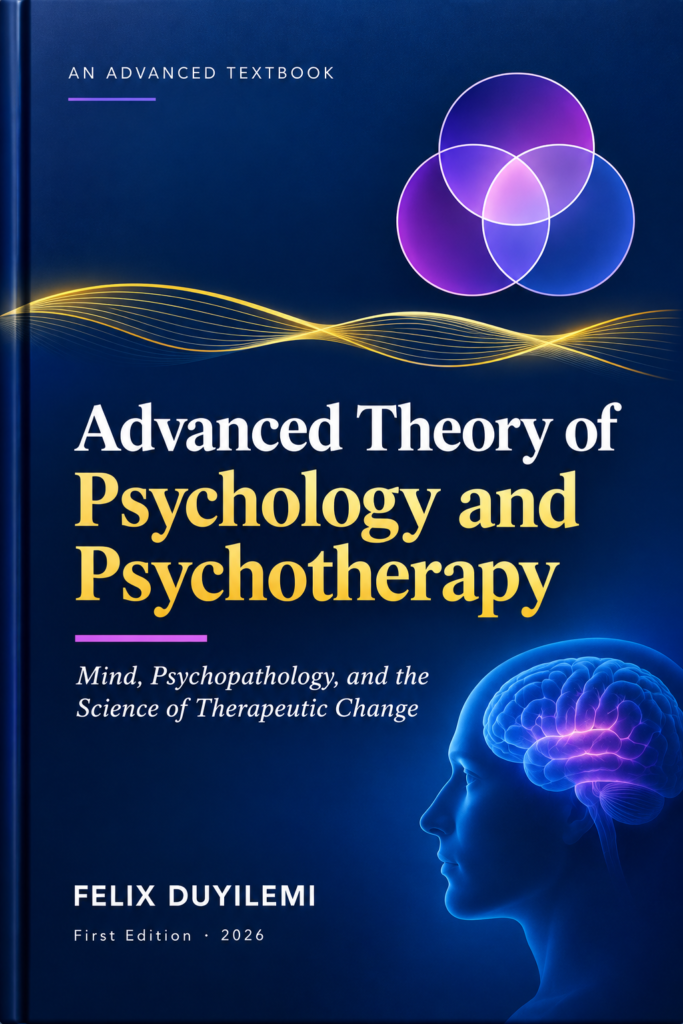
Advanced Theory of Psychology and Psychotherapy: Mind, Psychopathology, and the Science of Therapeutic Change
About this book
An advanced psychology and psychotherapy textbook for university students, counsellors, clinical psychology trainees and mental health professionals in Nigeria, Africa and worldwide
Are you looking for a psychology textbook that brings together psychological theory, psychopathology and psychotherapy in one book?
Advanced Theory of Psychology and Psychotherapy is a 206-page advanced psychology book for undergraduate, postgraduate, master's and PhD students in psychology, clinical psychology, counselling psychology, psychiatry, social work, nursing and guidance and counselling.
It also suits practising therapists, counsellors and mental health workers.
The book explains why people suffer psychologically and how psychotherapy helps them change.
It moves from the biological, psychological and social foundations of the mind to the causes and classification of mental disorders, then to the major schools of psychotherapy and counselling theory, and finally to case formulation, assessment, ethics and global mental health.
What you will learn
Foundations of the mind: the biopsychosocial model, the brain and behaviour, neuroplasticity, the HPA axis and the stress response, allostatic load, emotion regulation, attachment theory and internal working models.
Psychopathology and abnormal psychology: the diathesis-stress model, harmful dysfunction, DSM-5 and ICD-11, HiTOP and dimensional classification, transdiagnostic processes, and cultural concepts of distress such as brain fag.
Anxiety, depression, OCD, PTSD and complex PTSD: cognitive models of panic, social anxiety and generalized anxiety disorder, Beck's negative cognitive triad, and how each disorder is maintained.
Psychodynamic theories and therapies: Freud's topographical and structural models, defence mechanisms, transference and countertransference, object relations, mentalization, Malan's triangles and short-term psychodynamic psychotherapy.
Behaviour therapy: classical and operant conditioning, functional analysis, exposure therapy, inhibitory learning, exposure and response prevention, and behavioural activation.
Cognitive behavioural therapy (CBT): automatic thoughts, core beliefs, cognitive distortions, behavioural experiments, the ABC model, and metacognitive therapy.
Third-wave and contextual therapies: mindfulness, acceptance and commitment therapy (ACT), the hexaflex, psychological flexibility, dialectical behaviour therapy (DBT) and compassion-focused approaches.
Humanistic, person-centred and experiential therapies: Carl Rogers' core conditions, unconditional positive regard, congruence, empathy, emotion-focused therapy and motivational interviewing.
Interpersonal, family and systemic therapies: interpersonal psychotherapy (IPT), genograms, expressed emotion and family systems.
Trauma-focused therapies: psychological first aid, prolonged exposure, cognitive processing therapy (CPT), EMDR, narrative exposure therapy, TF-CBT and trauma-informed care.
Case formulation and assessment: the 5 Ps, the mental state examination, measurement-based care and the reliable change index.
The science of therapeutic change: common factors, the therapeutic alliance, alliance ruptures, therapist effects, Wampold's contextual model and the dodo bird verdict.
Ethics, risk and suicide prevention: confidentiality, supervision, the interpersonal theory of suicide and safety planning.
African and global mental health: Lambo and the Aro village system, the Nigerian National Mental Health Act 2021, the treatment gap, task-sharing, the Friendship Bench, group IPT in Uganda, the COSIMPO trial and the IASC pyramid for mental health in emergencies.
Why this psychology textbook stands out
5 parts and 20 chapters, each with learning objectives, case illustrations, tables, a chapter summary, key terms, review questions and further reading.
22 diagrams that make complex theories easy to see, including Clark's panic cycle, Freud's iceberg model, Malan's triangles, the ACT hexaflex, the CBT model and the IASC pyramid.
A glossary of 82 key terms and more than 180 academic references.
Written with a Nigerian and African perspective and an international, evidence-based scope.
Useful as a course textbook, exam revision guide, research reference and practitioner's handbook.
Who this book is for
Psychology students; clinical and counselling psychology trainees; psychiatry residents; psychiatric nurses; social workers; guidance counsellors; lecturers teaching abnormal psychology, theories of counselling, psychotherapy or clinical psychology; and anyone who wants a serious
introduction to psychotherapy theory and practice.
Order your copy of Advanced Theory of Psychology and Psychotherapy today.
Start a reading club for this book, or join one.
You may also like
About the Author

Award-winning author, international speaker and Founding Pastor of Christ Classic Global Ministry