
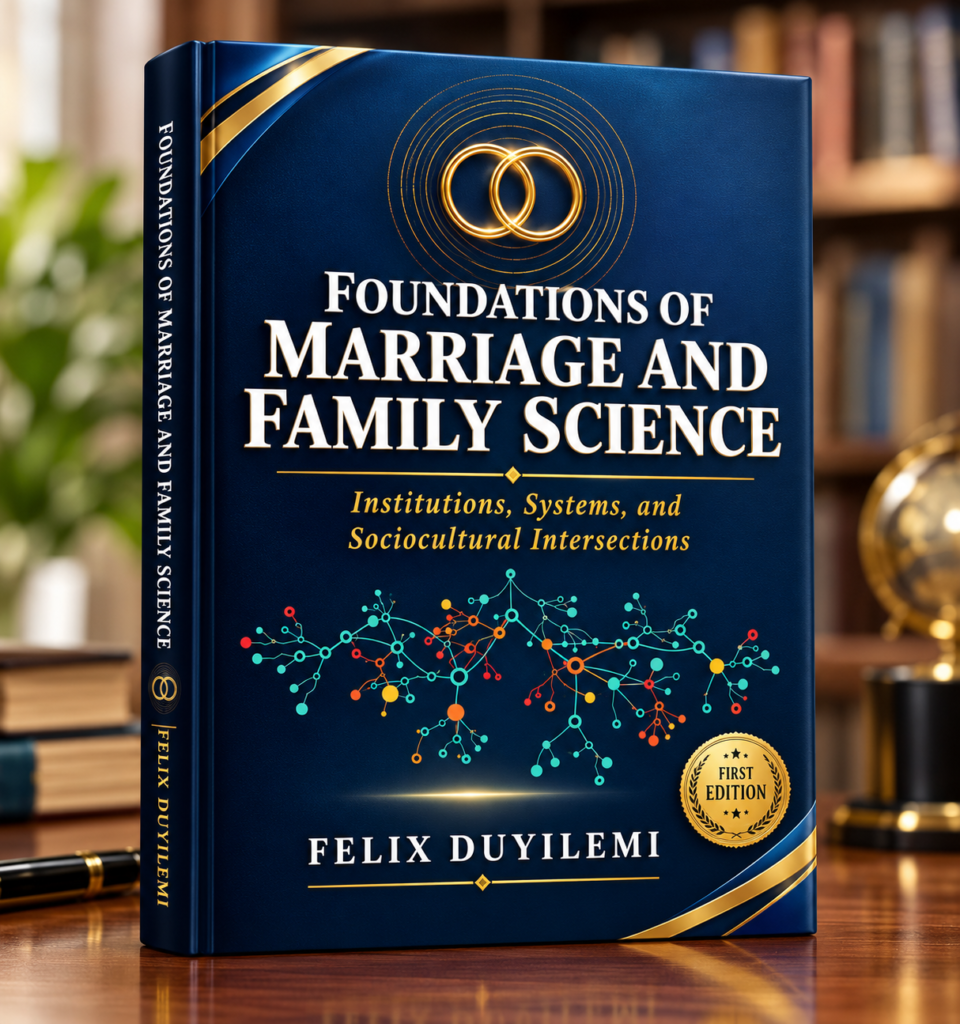
Foundations of Marriage and Family Science: Institutions, Systems, and Sociocultural Intersections
About this book
This is a complete, PhD-level textbook on marriage and family science for graduate students, lecturers, researchers, counsellors and family therapists.
It moves beyond description to theory, research methods and critical analysis, giving you a working command of family sociology, family studies and family systems thinking.
Most family studies textbooks treat the Western nuclear family as the norm. This one doesn't. It sets the classic research in a global, comparative frame, with in-depth coverage of African family systems and Nigerian family life: lineage, the compound, seniority, bridewealth, polygyny, child fosterage, and the country's statutory, customary and Islamic marriage law.
Inside this marriage and family textbook:
Family theories explained in depth: structural functionalism, family systems theory (Bowen, Minuchin, the Circumplex Model), Bronfenbrenner's ecological theory, the life course perspective, social exchange and investment models, symbolic interactionism, and feminist, intersectional and decolonial theory.
Family stress and resilience: Hill's ABC-X model, the Double ABC-X model, ambiguous loss, and Walsh's family resilience framework.
Research methods in family science: longitudinal and dyadic designs, the Actor-Partner Interdependence Model, qualitative and mixed methods, and research ethics.
Marriage and relationships: mate selection, cohabitation, marital quality, Gottman's research, divorce and its effects on children, remarriage and stepfamilies.
Parenting and child development: parenting styles, fatherhood, coparenting, and the Family Stress Model.
Intergenerational relationships and aging families: caregiving, grandparents and elder care.
Family violence: intimate partner violence, child abuse, harmful widowhood practices, and how to prevent them.
Gender, work and family: the division of household labour, work-family conflict, and welfare policy.
Family law and policy: Nigerian family law, cash transfers, and international human rights.
Globalization and the future of the family: transnational families, migration ("japa"), digital technology and assisted reproduction.
Built for teaching and exam preparation: each of the 20 chapters includes learning objectives, case study boxes, tables, diagrams, a chapter summary, key terms, doctoral-level discussion questions and suggested readings.
A full glossary and reference list are included, which makes the book well suited to comprehensive exam preparation, seminar teaching and thesis research.
Ideal for: postgraduate students in sociology, family studies, human development, social work, psychology, marriage and family therapy, gender studies and African studies; university lecturers looking for a course textbook; and practitioners in family counselling, family policy and family life education.
Get your copy today and master the foundations of marriage and family science.
Start a reading club for this book, or join one.
You may also like
About the Author

Award-winning author, international speaker and Founding Pastor of Christ Classic Global Ministry