
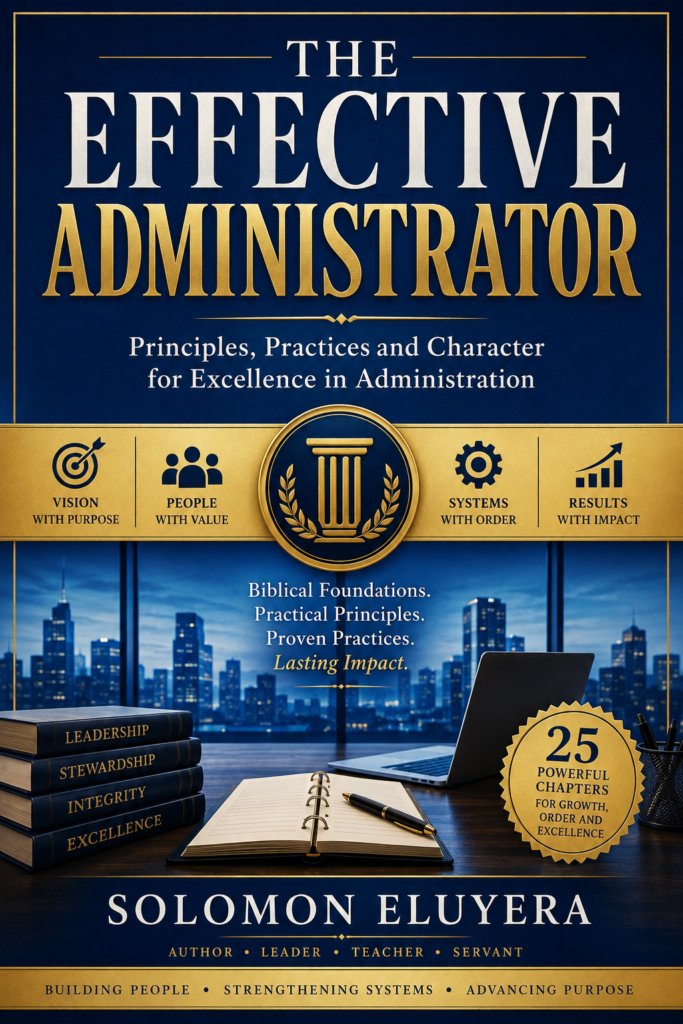
THE EFFECTIVE ADMINISTRATOR
About this book
Every organization requires administration.
Whether the organization is large or small, formal or informal, commercial or nonprofit, administrative responsibility exists whenever people, resources, activities, information, and objectives must be coordinated.
Administration answers a fundamental question:
How do we organize what we have so that we can accomplish what we are responsible for?
This makes administration a strategic function.
An administrator may work behind the scenes, but the results of administration are visible everywhere.
When administration is effective, people experience:
clarity;
order;
timely communication;
proper coordination;
accountability;
responsible resource use;
reliable records;
effective service.
When administration is weak, people may experience:
confusion;
delays;
duplication;
waste;
conflict;
poor communication;
financial disorder;
missed opportunities.
Therefore, administration matters.
ADMINISTRATION AND LEADERSHIP
Leadership and administration are closely connected, but they are not identical.
Leadership provides direction and influence.
Administration provides organization and execution.
Leadership may ask:
Where are we going?
Administration asks:
How will we get there effectively?
Leadership may establish vision.
Administration translates vision into:
plans;
schedules;
responsibilities;
systems;
procedures;
budgets;
communication;
measurement.
An organization needs both.
THE ADMINISTRATOR AS A STEWARD
Administration is fundamentally about stewardship.
An administrator is entrusted with something that belongs to a larger purpose.
Start a reading club for this book, or join one.
You may also like
About the Author

Pastor Solomon Eluyera is a devoted servant of God whose life is a testimony of God's grace, faithfulness, and divine purpose. His journey into ministry began with a deep conviction to proclaim the Gospel of Jesus Christ and to see lives transformed through the power of God's Word. Serving under Living Faith Church Worldwide, he is committed to preaching the Gospel, discipling believers, mentoring leaders, and equipping Christians to fulfill their God-ordained destinies.