
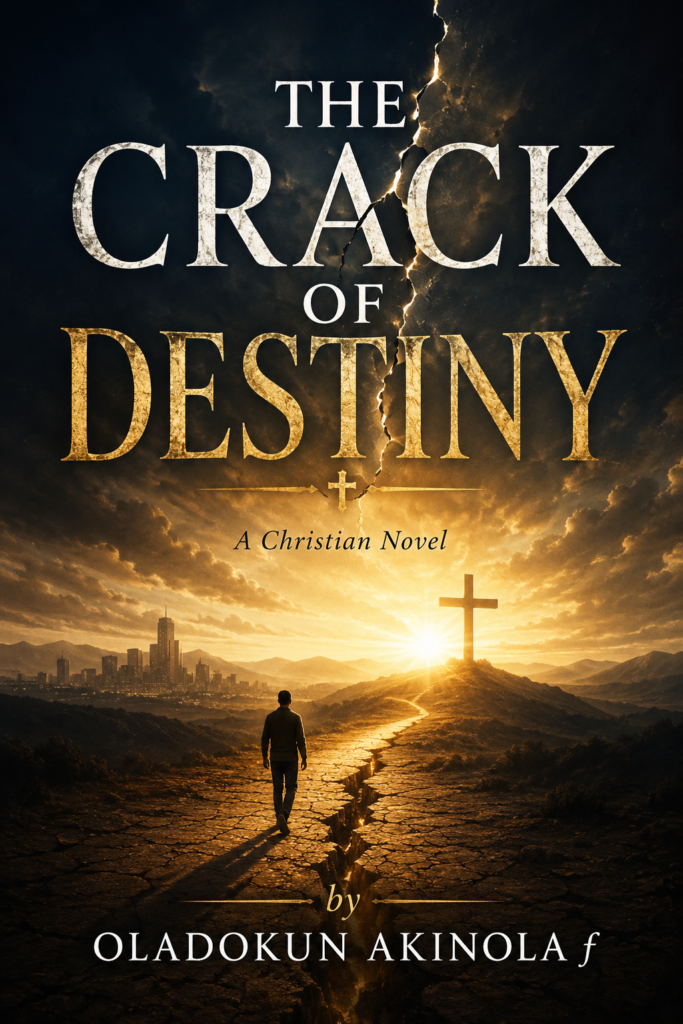
The Crack of Destiny
About this book
About the Book.
A clay pot falls. It cracks — but it does not break.
That single moment, on a red dust road in Oke-Ado in 1971, becomes the heartbeat of one of the most deeply human, deeply honest novels to come out of Nigerian Christian fiction. The Crack of Destiny is a sweeping, fifty-five-year story of three families — Yoruba, Igbo, and Tiv — bound together not by blood, but by a God who refuses to let broken things remain broken.
Adunni Adewale is born the same night her father mends a cracked clay pot with melted glass and palm oil, setting it, unashamed, on the highest shelf in the house. Chibuike Okonkwo-Eze grows up in the silence of a father who never came home from the war, raised by a mother whose faith is not theory but testimony. Terhemba Iyornumbe stands between two rivers — his father’s world and his mother’s God — and must choose, at real personal cost, which one he will follow.
Across decades of harmattan winds and Lagos hustle, of indigo dye vats and highway accidents, of mass graves and revival tents, of corruption confessed and wrongs painstakingly repaid, all three are broken in different ways and by different hands. And across those same decades, the same God — patient, faithful, unhurried — is at work in every crack, every seam, every season that looks, from the inside, like simple destruction.
This is not a story that pretends grief is secretly easy, or that faith protects a person from loss. It is something far more valuable: a story that tells the truth about both the breaking and the mending, and insists, on every page, that the two cannot be separated — because it is precisely in the cracked places that the maker’s hand is most clearly seen.
The Crack of Destiny is a novel about faithfulness rewarded and hope restored. It is about a son who wandered far and a Father who ran to meet him. It is about a brother whose killer asked to be forgiven and a grieving man who found, after fifteen years of honest wrestling, that he could. It is about three rivers — one from the west, one from the east, one from the north — that flow through entirely different landscapes, survive entirely different storms, and arrive, finally, at the same confluence.
“Behold, I make all things new.” — Revelation 21:5 (RSV)
It is, above all, a novel for everyone who has ever been told that what is cracked in them is finished. It is not finished. The maker’s hand is still on the wheel.
Start a reading club for this book, or join one.
You may also like
About the Author

About the Author Oladokun Akinola F. is a Christian author, inspirational writer, and graduate of English from the University of Ibadan, Nigeria. He is passionate about helping people grow in their relationship with God through the transforming power of His Word. His writings encourage readers to discover their identity in Christ, strengthen their faith, and live victoriously according to biblical principles. A devoted lover of gospel music, Oladokun believes that worship and God's Word work together to draw believers into a deeper fellowship with the Lord. His writing blends sound biblical truth with practical encouragement, making timeless spiritual principles relevant to everyday life. His works focus on motivation, inspiration, spiritual growth, Christian living, and faith, with the desire to inspire readers to trust God wholeheartedly and walk confidently in His purpose. Oladokun draws inspiration from the Word of God, the guidance of the Holy Spirit, lessons learned through personal life experiences, and the quiet moments of meditation where creativity is stirred and biblical truths come alive. Through every book he writes, his prayer is that readers will encounter God's love, grow in spiritual maturity, and be equipped to live lives that glorify Jesus Christ.