
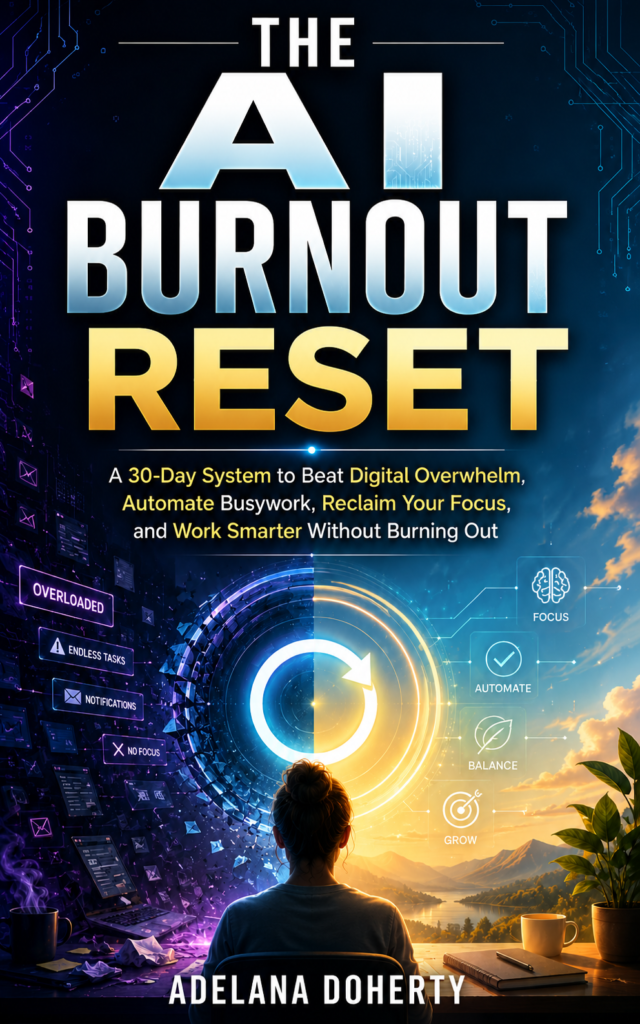
THE AI BURNOUT RESET
About this book
AI Was Supposed to Give You Your Time Back.
Something strange is happening at work.
We have more technology designed to save time than any generation before us, yet millions of professionals feel they have less time than ever.
Your computer is faster.
Your phone can connect you to almost anyone.
Your documents live in the cloud.
Meetings can happen from anywhere.
Software can schedule appointments, organize projects, summarize information, draft emails, analyze spreadsheets, create presentations, generate images, translate languages, transcribe conversations, and now, with artificial intelligence, perform tasks that once required hours of human effort.
By every logical measure, we should be swimming in spare time.
Instead, many of us are drowning in tabs.
The workday has expanded into something shapeless. Email begins before breakfast. Notifications arrive while you are concentrating. Messages wait while you are in meetings. Meetings create tasks. Tasks create documents. Documents create revisions. Revisions create more messages.
Then AI arrives and promises relief.
At first, it feels miraculous.
A report that once took two hours can begin in two minutes.
A difficult email can be drafted instantly.
A long document can be summarized.
Meeting notes can appear automatically.
Ideas can be generated by the dozen.
Suddenly, you can do more.
And that is precisely where the problem can begin.
Because organizations, clients, managers, and sometimes our own ambition rarely respond to increased capacity by saying:
“Wonderful. You finished early. Please go home and enjoy your life.”
Instead, the empty space gets filled.
The faster report produces another report.
The saved hour becomes another meeting.
The automated task creates room for three new tasks.
The person who learns AI becomes the person everyone asks to do more.
Efficiency quietly turns into expectation.
Your tools get faster while your nervous system stays human.
That is the central problem this book is designed to solve.
The Goal Is Not Maximum Productivity.
This is not a book about squeezing maximum output from every waking minute.
You are not a factory.
Your value is not measured by the number of tasks you can stuff into a Tuesday.
There is a profound difference between productive work and permanent acceleration.
Productivity should create capacity.
Start a reading club for this book, or join one.
You may also like
About the Author

Writing books have always been passion for me and my readers have always appreciated the good works contained in all the books I've either written or compiled. It's my great pleasure writing, writing and writing.