
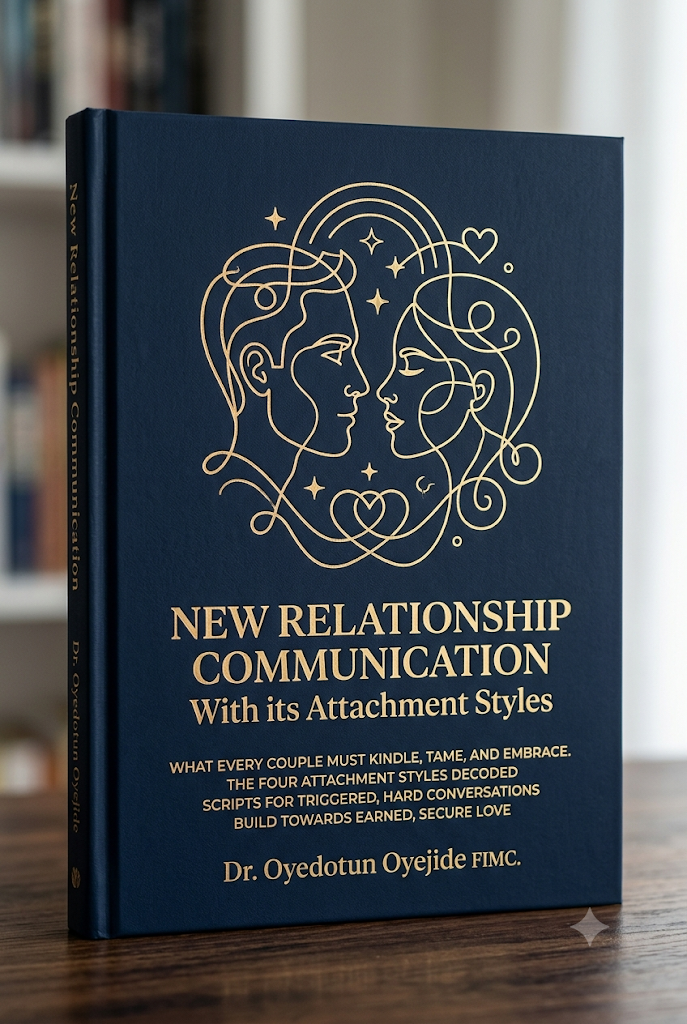
New Relationship Communication With Its Attachment Styles: What Every Couple Must Kindle, Tame, and Embrace
About this book
New Relationship
Communication
With Its Attachment Styles: What
Every Couple Must Kindle, Tame, and
Embrace
By Dr. Oyedotun Oyejide, FIMC
Why Do the Same Fights Keep
Happening — With Different
Partners?
The Answer Isn't Bad Luck. It's
Attachment. Here's How to
Finally Understand It — and
Communicate Your Way to
Something Secure.
For Instant,…
You send a text. An hour passes
with no reply. And suddenly you're
spiraling — checking your phone
every two minutes, replaying the
last conversation, wondering what
you did wrong.
Or maybe it's the opposite: things
start feeling close, real, serious —
and something in you wants to pull
back. Make an excuse. Create a
little distance, just to breathe.
Neither reaction is really about the
person in front of you. It's older than
that. It's attachment — the deep,
often invisible blueprint you built
years ago for what closeness
means and whether it can be
trusted. And until you understand it,
it will keep running the show in
every relationship you're in.
THE PROBLEM
Here's what usually happens, and
almost nobody has the language for
it in the moment:
One partner reaches for
reassurance; the other partner
reads that reaching as pressure
— and pulls away, which makes
the first partner reach even
harder.
A relationship starts feeling
serious, and instead of
excitement, one partner feels a
quiet urge to create distance —
and can't explain why.
Arguments about small things (a
late reply, a cancelled plan) spiral
into much bigger conversations
about whether the relationship is
even secure.
Both partners are doing
everything they know how to do
— and it still doesn't feel safe.
This isn't a compatibility problem.
It's an attachment pattern problem
— and attachment patterns can be
named, understood, and changed.
THE TURN (there's a way
through)
New Relationship Communication
is a clear, research-grounded guide
to attachment theory — built
specifically for the real, practical
work of communicating well in a
new or developing relationship.
Grounded in the foundational
research of John Bowlby, Mary
Ainsworth, and Cindy Hazan and
Phillip Shaver, alongside Dr. Sue
Johnson's Emotionally Focused
Therapy and Dr. Stan Tatkin's
secure-functioning framework, this
book doesn't just explain
attachment styles —
it gives you the
actual words to use when your
attachment fears show up mid conversation.
WHAT'S INSIDE
Part One — Kindle: Building the
Foundations of New Love
What attachment theory actually is,
and why new relationships trigger
old wiring.
The four attachment
styles, clearly defined. How to
honestly identify your own patterns
— and how to read a new partner's,
early, with curiosity instead of
alarm.
Part Two — Tame: Navigating
Triggers, Fears, and Conflict
The anxious-avoidant pairing,
decoded — why it happens and how
it doesn't have to be doomed.
Specific tools for taming protest
behavior (for anxious partners) and
taming withdrawal (for avoidant
partners).
Word-for-word scripts for
fighting fair when attachment fears
take over. How to interrupt the
pursue-withdraw cycle together, as
a team — not opponents.
Part Three — Embrace: Building
Toward Secure, Lasting Love
Why your attachment style isn't a
life sentence — the real research
behind "earned security." Concrete,
build able habits for secure functioning
relationships. How to
stay vulnerable without losing
yourself. Navigating major
milestones — meeting family,
moving in, commitment — through
an attachment-aware lens.
Plus, a full workbook:
10 ready-to-use conversation
scripts for the moments that are
hardest to find words for
An attachment self-reflection
worksheet
A weekly relationship check-in
Template and Guided journal page!
WHO THIS IS FOR?
Anyone dating or in a new
relationship who wants to
understand their own patterns
before old habits repeat
themselves
Couples who recognize the
anxious-avoidant "chase and
withdraw" dynamic and want out
of it
Partners who've been told to
"communicate better" without
ever being given the actual words
Anyone who's ever wondered why
the same relationship dynamic
keeps showing up with different
people
WHO THIS ISN'T FOR
This is not a substitute for licensed
therapy or a clinical diagnostic tool.
If your relationship involves
coercion, control, or fear for your
safety, this book will point you
toward the right kind of help — but it
isn't that help itself. (Covered
directly inside.)
THE PROMISE (honest,
not hyped)
We won't tell you that reading this
once will make your attachment
patterns disappear. Attachment
What we will give you: a clear map
of what's actually happening
underneath your hardest
conversations, and the specific,
practiced language to communicate
your way toward something more
secure — one honest conversation
at a time.
SOCIAL PROOF
"We finally
had a name for what kept happening
between us — [Romoke Olugbare] and the scripts in
Chapter 9 got us through our first
real fight without it turning into a
disaster." — [Ayoola Kazeem]
THE OFFER:
New Relationship Communication:
With Its Attachment Styles — What
Every Couple Must Kindle, Tame,
and Embrace
By Dr. Oyedotun Oyejide, FIMC
58 pages. Instant PDF download.
Read on any device.
[BUY NOW BUTTON — $[PRICE]]
Instant access. Start understanding
your patterns tonight.
FAQ (objection handling)
"Is this only for people already in a
relationship?
"
No — it's equally useful for anyone
dating, since understanding your
own attachment patterns before
you're deep in a relationship is often
the most valuable time to learn
them.
"What if my partner won't engage
with this material?"
Start by reading it yourself and
modeling the communication
practices directly — Chapter 18
addresses this exact question in
detail.
"Is this a replacement for couples
therapy?"
No, and the book says so clearly. It's
a strong, practical foundation — and
it tells you plainly when it's time to
bring in a licensed professional
instead.
"I don't know my attachment style
— will this still make sense?"
Yes. Chapter 3 walks you through
identify"Is this too academic or clinical?"
nag your own patterns step
by step, with reflection questions
rather than a rigid quiz
.
No — while it's grounded in real
psychological research, it's written
in plain, practical language, with
scripts and worksheets designed
for real conversations, not a textbook.
CLOSING
You didn't choose your attachment
style. But you can
GET A COPY NOW AND EXPERIENCE A CHANGE FOR BETTER
YOU ARE ABOUT TO HAVE A TURN AROUND FOR GOOD IF YOU CAN INVEST A TOKEN NOW!
Start a reading club for this book, or join one.
You may also like
About the Author

Dr. Oyedotun Oyejide Dr. Oyedotun Oyejide, popularly known as Smart Oyedotun Oyejide, is a Nigerian author, publisher, journalist, educator, literary consultant, and inspirational speaker. He is recognized for his contributions to literature, publishing, journalism, and literacy development in Nigeria. His writings span fiction, poetry, children's literature, Christian literature, personal development, entrepreneurship, education, and social commentary. Early Life Oyedotun Oyejide was born in Ibadan, Oyo State, Nigeria. He developed an interest in reading and creative writing at an early age and began writing while still a child. His passion for literature evolved into a lifelong career dedicated to educating, inspiring, and empowering readers through books and journalism. Education Dr. Oyejide pursued higher education in Nigeria, developing academic and professional interests in communication, literature, journalism, publishing, and education. His academic training has complemented his practical experience across the media and literary industries. Career Dr. Oyejide has built a multifaceted career as an author, publisher, journalist, editor, educator, and media consultant. Throughout his professional life, he has contributed to the promotion of literacy, ethical journalism, creative writing, and knowledge sharing. As an author, he has written extensively across several genres, including novels, poetry, inspirational literature, business, leadership, Christian living, children's books, and educational materials. His works reflect a commitment to moral values, intellectual growth, entrepreneurship, and national development. In journalism, he has served in editorial and publishing capacities, producing articles and commentaries on contemporary social, educational, and developmental issues. He has also worked as a lecturer in Mass Communication, mentoring students and aspiring media professionals while encouraging excellence in communication and responsible journalism. Beyond writing, Dr. Oyejide has actively supported emerging writers through mentoring, publishing initiatives, and literary advocacy, promoting a culture of reading and creative expression. Literary Contributions Dr. Oyejide's literary output includes books, e-books, articles, essays, poems, and plays covering a wide range of subjects. His work seeks to combine education with inspiration, encouraging readers to embrace lifelong learning, ethical leadership, entrepreneurship, and faith-based living. His writings consistently emphasize the transformative power of books and the importance of preserving African stories and values for future generations. Philosophy Dr. Oyejide believes that literature is a catalyst for personal transformation and national development. He has consistently advocated for reading, education, creativity, integrity, and purposeful leadership as foundations for building stronger communities and future generations. Public Speaking As a conference speaker and literary advocate, Dr. Oyejide has addressed audiences on writing, publishing, journalism, leadership, entrepreneurship, literacy development, education, Christian living, and personal growth. His presentations combine practical experience with motivational insights aimed at empowering individuals and institutions. Selected Works Among his published works are novels, inspirational books, educational publications, business guides, Christian literature, and numerous articles. His writing portfolio reflects decades of dedication to knowledge dissemination and creative expression. Legacy Dr. Oyedotun Oyejide is regarded as an advocate for literacy, publishing, and lifelong learning. Through his books, journalism, teaching, and mentorship, he has sought to encourage readers and aspiring writers to use knowledge as a tool for personal achievement and social progress. His enduring vision is to leave a legacy of informed minds, empowered communities, and a vibrant culture of reading across Africa and beyond.