
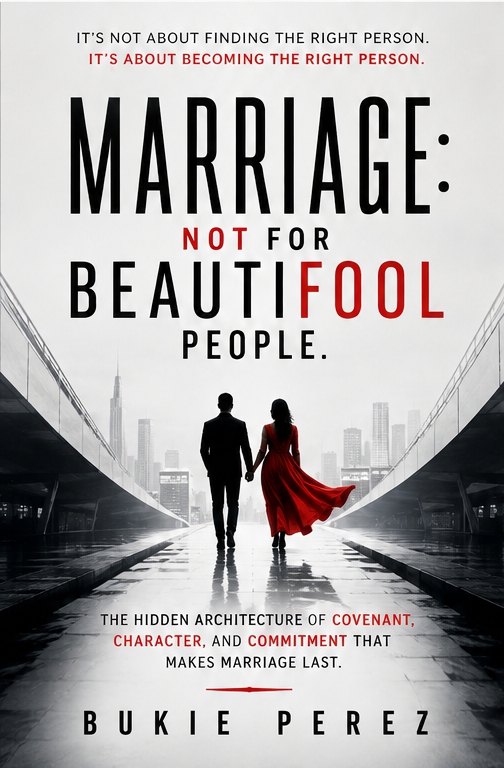
Marriage:Not For Beautifool People
About this book
You Are Cute. Breathtaking Even.
But...
ARE YOU BEAUTIFUL OR BEAUTIFOOL?
Not physically.
In love.
Because there is a difference.
A beautiful person may know how to attract love.
A BEAUTIFOOL may know how to attract it—and then destroy it.
A beautiful person says:
"I love you."
A BEAUTIFOOL says:
"I love you—as long as you keep making me happy."
A beautiful person understands sacrifice.
A BEAUTIFOOL calls sacrifice exploitation.
A beautiful person understands commitment.
A BEAUTIFOOL calls commitment imprisonment.
A beautiful person can forgive.
A BEAUTIFOOL keeps the past loaded and ready.
A beautiful person asks:
"What can I give?"
A BEAUTIFOOL keeps asking:
"What am I getting?"
A beautiful person understands that feelings change.
A BEAUTIFOOL assumes that changing feelings cancel permanent promises.
And here is the uncomfortable part:
You may be beautiful in every way people can see—and still be a BEAUTIFOOL in love.
Because BEAUTIFOOL is not about your face.
It is about your posture toward love.
So what is your posture?
Do you love to be loved?
Do you love to be desired?
Do you love to be served?
Do you love to be free?
Do you love to win?
Do you love to be right?
Or have you learned to love another person's flourishing even when it costs you something?
That is where this book begins.
Marriage: Not For BEAUTIFOOL People is not primarily asking whether you have found the right person.
It asks whether you are becoming the right person.
Because marriage eventually exposes your posture.
And when attraction is no longer enough, your posture becomes your relationship.
Your character becomes your marriage.
Your capacity becomes your future.
So before you ask, "Who should I marry?"
Find out what kind of lover you are.
Beautiful?
Or BEAUTIFOOL?
You may discover that the most important person you need to understand before marriage is yourself.
Get the book.
My strongest three for the actual advertising funnel are Version 2 for cold traffic, Version 3 for emotionally wounded/relationship-aware readers, and the BEAUTIFUL/BEAUTIFOOL version for the most provocative campaign.
The last one has a particularly strong mechanism: the reader cannot comfortably classify themselves without examining their own behaviour. That creates the exact curiosity gap you want: “What love posture defines me?”
Start a reading club for this book, or join one.
You may also like
About the Author
