
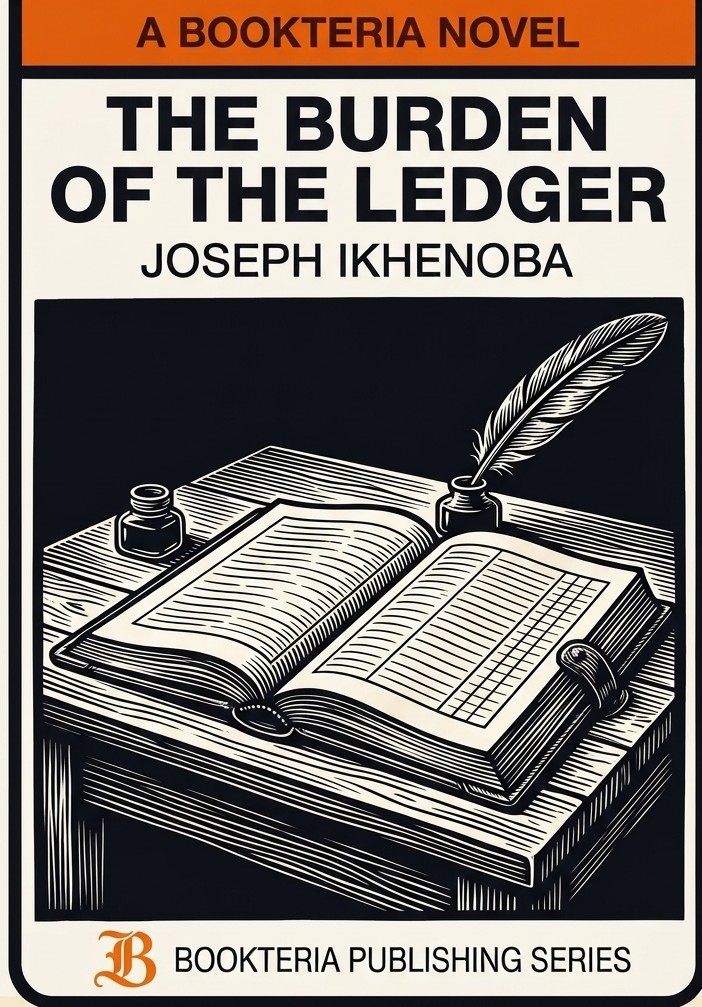
BURDEN OF THE LEDGER
About this book
In a decaying stilt house suspended over a silt-choked Nigerian delta, Beinmonyo and Oyeinmiebi exist in a state of quiet psychological stasis. For fifteen years, Beinmonyo has meticulously maintained a blue exercise book—a record of uncollected debts, failed crops, and periwinkles left unpaid. He clings desperately to his late father's radical belief: "If we write what's left, we will remember who we are." Oyeinmiebi, weary and fiercely pragmatic, sees the ledger for what it truly is: a monument to futility in a home rapidly being reclaimed by both the river and modern industrial encroachment.
Their only daughter, Brakemi, has already broken the cycle. On a quiet Tuesday, she packed her blue gowns and her tin of needles, leaving behind only a bush-cow horn comb with two broken teeth on the windowsill. Tying her bundle with her grandmother's traditional knots, she walked the dry path toward the mainland timber camp, a place where workers are paid in real, unrotting silver.
As the harmattan haze settles over a retreating tide, the modern world finally breaches their isolation. A corporate syndicate advances up the channel with diesel launches, pink survey string, and red stakes. Though the local catechist warns that their home sits squarely in a designated "red zone," Beinmonyo remains frozen.
On a decisive Friday morning, the corporate winches arrive. Labourers in yellow helmets drive a boundary stake directly into the centre of Beinmonyo's ancestral fishing ground, shouting a final warning: "Company goes drive pile here next week! You must come out!" Hearing rumours that Brakemi now cooks for the sawyers and earns her own silver, Oyeinmiebi finally stops fighting her husband over the book. The domestic battleground clears, leaving Beinmonyo alone with his archive.
Faced with eviction, Beinmonyo looks at his final entry: Chidi — 3 copper coins — periwinkles — still owing. Cash, none. The phrase has been written seven times that month alone. As the harmattan wind catches the twine spine, it flips the pages to the back, revealing ten empty pages. In a crushing moment of clarity, Beinmonyo realises the devastating truth: he has been guarding blank paper.
In one final, liberating action, he holds the blue exercise book over the sill and lets go. It lands flat on the incoming tide. The warped cardboard drinks the salt water as the palm oil stains, charcoal soot, and cheap Bic ink bleed into the uniform grey of the landscape. The river, which he thought had forgotten how to wash the house away, finally remembers its purpose.
Oyeinmiebi is the first to step down into the cold mud, walking barefoot toward the waiting launch. Beinmonyo leaves his mother's horn comb on the sill and follows, lifting his hip to clear the worn floorboard for the very last time. Behind them, the river carries the ink toward the sea, but the mud keeps the shape of their going. Ahead lies the smoke of the timber camp, the shouting of the sawyers, and Brakemi.
Start a reading club for this book, or join one.
You may also like
About the Author
